

Enterprise SaaS SEO: How It’s Different & How to Do It

“Can’t we just scale up our regular SEO approach?”
That’s what the VP of Marketing asked me during our first call. Their Series C SaaS company had grown from 50 to 500 employees in two years. Traffic was flat.
I pulled up their site. 12,000 pages. Four product lines. Six different subdomains. Two recent acquisitions with their own domains.
“Your regular SaaS SEO approach is like bringing a bicycle to a highway,” I told him.
Enterprise SaaS SEO isn’t just regular SEO at scale. It’s a completely different beast.
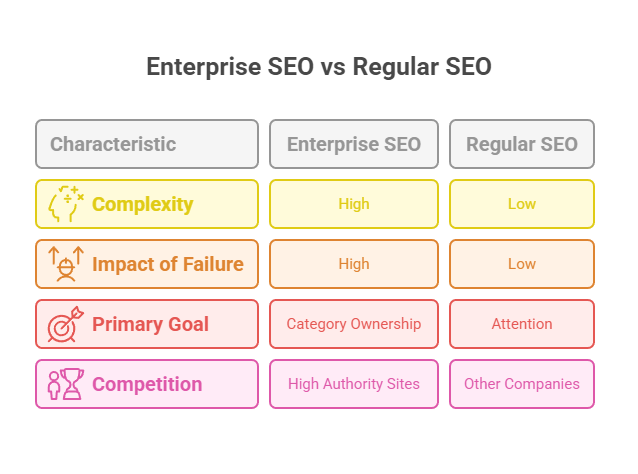
Why Enterprise SEO Is Different from Regular SEO
I first heard about enterprise SEO when I was working with Druva.
It hit me totally different when Jaspreet Singh, the CEO said – “We do not want a lot of window shoppers, but just the right number of right people on our website.”
It’s Not Just Size – It’s Complexity
Enterprise SaaS SEO presents unique challenges. These include dynamic content generation and complex site structures. Dynamic content, like personalized dashboards, poses indexing hurdles for search engines.
Your startup had one product page. Now you have 47.
Your blog had 20 posts. Now you have 2,000.
Your team was three people who talked daily. Now it’s 30 people across five departments who barely know each other’s names.
The enterprise issues are complex, making general fixes quite tough to execute. For instance, to replace legacy content with new pages in an enterprise website, you must consider how the change will impact domain authority and internal linking.
Every change affects a hundred other things.
The Stakes Are Higher
However, if enterprise SEO campaigns go wrong, they directly impact a brand’s online image and the bottom line revenue of the company as well.
When a startup’s blog post underperforms, it’s annoying.
When an enterprise’s main product page tanks in rankings, it’s a quarterly revenue hit.
I’ve seen one bad migration cost a company $2M in lost organic revenue. The CMO got fired.
You’re Fighting Different Battles
Almost everything in the SaaS market has become digital. So, to keep up with the times, companies need high-level enterprise SEO teams and strategies to maintain a stable position in the market.
Regular SEO fights for attention.
Enterprise SEO fights for category ownership.
You’re not trying to rank for one product. You’re trying to dominate an entire software category.
Your competitors aren’t just other companies. They’re Wikipedia pages, industry reports, and analyst sites with decades of authority.
The Organizational Challenge
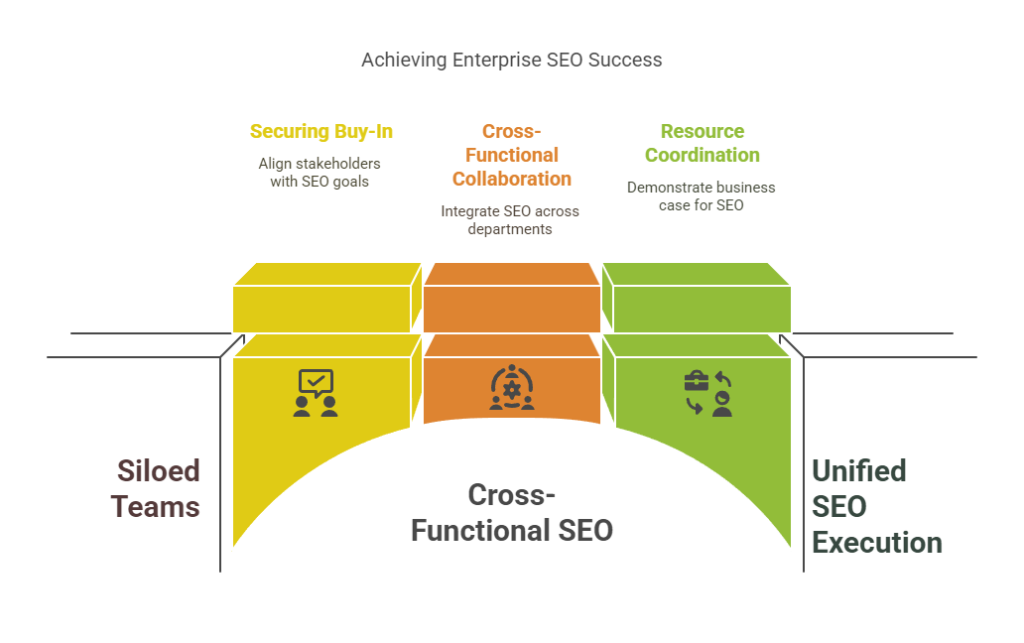
Getting Buy-In Is Half the Battle
Securing buy-ins ensures alignment and support across key stakeholders, which drives unified efforts toward SEO goals. Implementing necessary changes is challenging without buy-ins.
At a startup, the founder says “do SEO” and it happens.
At an enterprise, you need sign-off from:
- Product team (for feature page changes)
- Engineering (for technical implementation)
- Legal (for competitive content)
- Brand team (for messaging consistency)
- IT security (for tool access)
I once spent three months getting approval to update meta descriptions. Three months.
Cross-Functional Collaboration
Enterprise SaaS SEO requires seamless cross-functional integration with different teams to ensure success. Stakeholders from different departments – from production and purchase to marketing and PR may be involved in finalizing the ideas, resources, and content.
You’re not just working with marketing anymore.
Engineering needs to understand why page speed matters. Sales needs to understand why you can’t just add every feature to every page. Product needs to understand why user-generated content can hurt rankings.
Everyone has opinions. Most are wrong.
Resource Coordination
Resources from the product, marketing, and IT teams and SMEs will be required to execute the change. You’ll also need to demonstrate the business case for the resources and time required to make the change.
Every change requires a business case.
Want to fix your broken internal linking? That’s a dev sprint.
Want to update product descriptions? That’s a product marketing project.
Want to optimize for new keywords? That’s a content strategy overhaul.
Nothing happens fast.
Technical Differences

Dynamic Content Challenges
Dynamic content, like personalized dashboards, poses indexing hurdles for search engines. Solutions involve implementing dynamic rendering or server-side rendering to provide search engine-friendly versions.
Your product shows different content to different users.
Your pricing page changes based on company size.
Your feature pages adapt to user roles.
Google can’t see any of it.
You need server-side rendering, dynamic rendering, or static versions of key pages. Each solution has trade-offs.
Site Architecture Complexity
Enterprise website SEO differs from regular SEO as enterprise websites are vast, with thousands of pages, each holding the potential to turn visitors into paying customers.
Multiple product lines mean multiple site sections.
Acquisitions mean inherited domains and redirects.
Different regions mean localized content and hreflang tags.
B2B features mean login-gated content that needs special handling.
Your site architecture looks like a subway map. Google gets lost.
Scale Challenges
SEO tools and automation platforms are a must for enterprise SaaS SEO, as manually managing thousands of web pages is not feasible.
You can’t manually optimize 10,000 pages.
You can’t manually check 50,000 backlinks.
You can’t manually track 5,000 keywords.
Everything needs automation, templates, and systematic processes.
Strategic Differences
Keyword Strategy Complexity
Understanding user intent is crucial for successful enterprise SaaS SEO.
What is the motive of your customers in entering a specific keyword? Do they want to purchase a service, or do they just want relevant information about a certain topic?
Regular SaaS targets one buyer persona.
Enterprise SaaS targets:
- End users (who’ll actually use the product)
- Technical evaluators (who’ll assess implementation)
- Financial decision makers (who’ll approve the budget)
- Compliance officers (who’ll review security)
Each group searches differently. Each needs different content.
Content Strategy Scale
Choose your highest-value keywords and create the best piece of content on the Internet for each keyword in a systematic way.
You’re not creating content. You’re creating content systems.
Templates for product feature pages.
Frameworks for competitive comparisons.
Workflows for technical documentation.
Guidelines for regional variations.
Everything needs to be systematized or it falls apart.
Competitive Landscape
Since SaaS companies rely on building economies of scale to reduce costs and increase profit, a long-term strategy like organic SEO makes the most sense for SaaS businesses.
You’re not competing with other startups anymore.
You’re competing with:
- Public companies with million-dollar SEO budgets
- Industry publications with decades of domain authority
- Analyst firms with research teams
- Open source projects with passionate communities
David vs. Goliath, except Goliath has an SEO team.
How to Actually Do Enterprise SaaS SEO

Start with Inventory and Audit
Before you optimize anything, know what you have.
Site Audit:
- Map all domains, subdomains, and microsites
- Identify duplicate or conflicting content
- Document current site architecture
- Catalog all product pages and their relationships
Content Audit:
- Inventory existing content by product line
- Identify content gaps by buyer persona
- Find overlap and cannibalization issues
- Document content ownership by team
Technical Audit:
- Test dynamic content rendering
- Review internal linking structure
- Identify performance bottlenecks
- Document technical debt
This takes weeks, not days. Budget for it.
Build Your Team Structure
Things work differently at SaaS enterprises than at smaller businesses. To be successful, enterprise SEO SaaS requires cross-functional collaboration and seamless integration with other teams in a corporate environment.
Core SEO Team:
- SEO lead (strategy and coordination)
- Technical SEO specialist (implementation)
- Content strategist (planning and guidelines)
Extended Team:
- Product marketing (feature content)
- Engineering (technical implementation)
- Design (page optimization)
- Legal (competitive and compliance content)
Executive Sponsor: Someone with budget authority who understands SEO value.
Without executive sponsorship, you’ll spend more time in meetings than moving metrics.
Create Systematic Processes
An editorial calendar serves two functions: it organizes your content plan, and promotes consistency in your SEO deliverables.
Content Systems:
- Templates for each page type
- Approval workflows for each content category
- Guidelines for technical accuracy
- Standards for competitive claims
Technical Systems:
- Automated testing for core pages
- Monitoring for dynamic content issues
- Alerts for broken internal links
- Regular audits for new product launches
Measurement Systems:
- KPI dashboards by product line
- Attribution models for enterprise sales cycles
- Reporting templates for different stakeholders
Focus on High-Impact Areas
You can’t optimize everything at once. Prioritize ruthlessly.
Tier 1 (Immediate Impact):
- Core product landing pages
- Comparison pages vs. main competitors
- Solution pages for primary use cases
- Pricing and demo pages
Tier 2 (Medium Impact):
- Feature-specific pages
- Industry vertical pages
- Integration and API documentation
- Customer case studies
Tier 3 (Long-term Impact):
- Blog content and thought leadership
- Regional and localized content
- Technical documentation
- Community and user-generated content
Start with Tier 1. Get wins. Then expand.
Measure What Matters
The key KPIs for SaaS companies are: ROI: The total profit or loss compared to the cost of a marketing campaign; CAC: The total cost of all marketing efforts to acquire new customers, divided by the total number of new customers.
Pipeline Metrics:
- Organic MQLs by product line
- Pipeline value influenced by organic
- Sales cycle length for organic leads
- Win rate for organic-sourced deals
Authority Metrics:
- Share of voice for category keywords
- Backlinks from industry publications
- Brand mention volume and sentiment
- Citations in analyst reports
Efficiency Metrics:
- Organic CAC vs. paid CAC
- Content ROI by page type
- Technical debt reduction progress
- Cross-team collaboration effectiveness
Track quarterly, not monthly. Enterprise SEO moves slowly.
Common Enterprise SEO Mistakes
Trying to Move Too Fast
Enterprise SaaS SEO requires more time, planning, and patience than traditional SEO.
I get it. You want results.
But enterprise SEO is like turning an aircraft carrier. You plan the turn, execute slowly, and measure gradually.
Rushing leads to broken redirects, confused messaging, and political problems.
Underestimating Internal Politics
The best SEO strategy in the world fails if you can’t get it implemented.
Spend time understanding:
- Who really makes decisions
- Which teams have competing priorities
- Where the budget actually comes from
- What success looks like to different stakeholders
Politics matter more than PageRank.
Ignoring Technical Debt
If the SaaS company has a new product launch or undergoes a merger or acquisition, the layer of complexity grows.
Every enterprise has technical debt.
Legacy redirects from old domains. Duplicate content from acquisitions. Broken internal links from site migrations.
You can’t build new SEO success on a broken foundation.
Budget 30% of your time for fixing old problems.
Optimizing for Vanity Metrics
Traffic doesn’t matter if it doesn’t convert.
Rankings don’t matter if they’re for irrelevant keywords.
Backlinks don’t matter if they’re from irrelevant sites.
Focus on metrics that your CFO cares about: pipeline, revenue, and customer acquisition cost.
When to Build vs. Buy
Build In-House If:
You have 2+ years to see results.
You can dedicate 3+ full-time people.
You have strong executive sponsorship.
Your product changes frequently and requires constant SEO adjustments.
Hire an Agency If:
You need results in the next 12 months.
You don’t have internal SEO expertise.
You’re going through major technical changes (migrations, redesigns, acquisitions).
You want to focus internal team on product and sales.
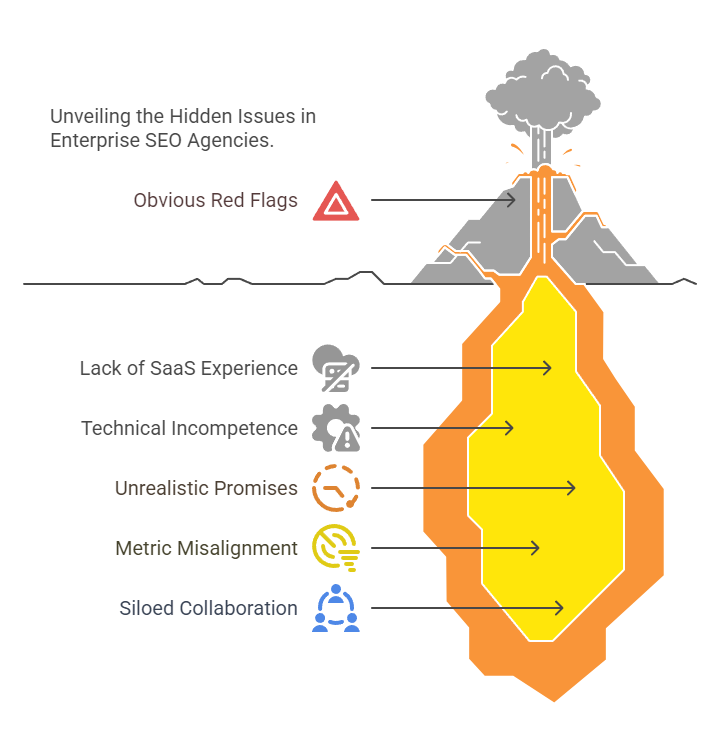
Red Flags in Enterprise SEO Agencies:
- Can’t show case studies from enterprise SaaS companies
- Don’t understand technical complexity of SaaS products
- Promise specific timelines for enterprise changes
- Focus only on traffic metrics, not business outcomes
- Don’t have processes for cross-functional collaboration
The Reality Check
Enterprise SaaS SEO is hard.
It’s slower than you want. More complex than you expect. More political than you’d like.
But when it works, it’s incredibly powerful.
While traditional SEO offers incremental value, enterprise SEO makes SaaS companies the market leader in organic search for a product category or industry.
You’re not just driving traffic. You’re building market authority.
You’re not just ranking for keywords. You’re owning categories.
You’re not just getting clicks. You’re influencing how buyers think about your entire market.
The companies that nail enterprise SEO don’t just grow faster. They become the default choice in their category.
That’s worth the complexity.
Managing enterprise SEO complexity? I’ll review your current approach and show you exactly where to focus first. No generic recommendations – just a real plan based on your specific organizational challenges and technical constraints.
